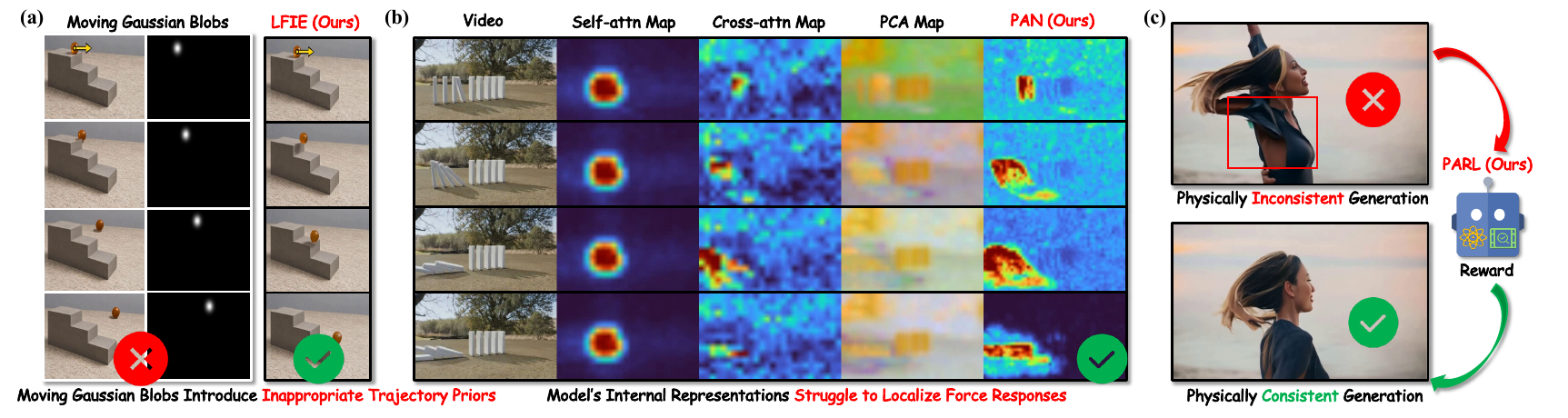
Inappropriate Trajectory Priors
Moving Gaussian blobs can make the model over-rely on encoded displacement patterns instead of inferring force-induced results.
 PhysForce
Interactive video world models aim to predict how visual environments evolve in response to user interventions, including physically consistent state changes induced by applied forces. Existing methods often represent forces as motion trajectories, which may introduce inappropriate motion priors, causing the model to over-rely on encoded displacement patterns. More fundamentally, the model's internal representations do not reliably localize force-induced state changes, making it difficult to associate applied forces with their resulting physical responses. Also, limited force-annotated data make it difficult to produce physically consistent and temporally stable predictions in unseen scenarios.
To address these limitations, we propose PhysForce, a two-stage framework that integrates supervised fine-tuning and reinforcement learning through three complementary components. During supervised fine-tuning, (1) the Latent Force Intervention Encoder maps force location, direction, and magnitude into the video latent space without exposing future motion; and (2) the Physics Attribution Network associates force interventions with localized changes in the latent state, strengthening the learning of physical responses to applied forces. During reinforcement learning, (3) Physics-Aware Reinforcement Learning uses self-supervised rewards on out-of-distribution videos to improve physical consistency and generalization. Extensive experiments show that PhysForce improves force responsiveness, physical consistency, and generalization, demonstrating its effectiveness for interactive video world models.
LFIE encodes force location, direction, and magnitude in the video latent space without trajectory leakage, allowing the model to predict state changes caused by the applied force.
PAN learns a force-conditioned response map that localizes state changes associated with the intervention.
PARL improves physical consistency and generalization using attribution-guided self-supervised rewards from videos, with a Dynamic Gate mitigating reward hacking.
PhysForce establishes a new state of the art on both OOD and ID benchmarks, decisively outperforming prior methods in force controllability and physics alignment while maintaining high visual quality and temporal coherence.
Relative gains compare PhysForce with the second-best method in each benchmark's qualitative evaluation.
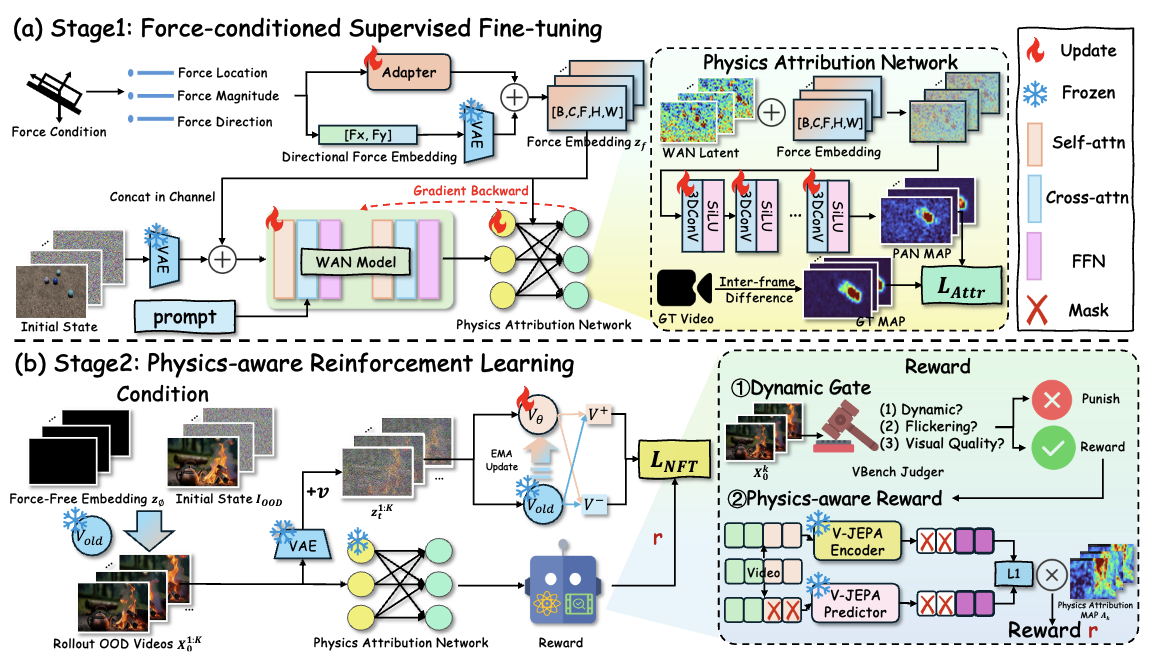
Figure 3. Overview of PhysForce. Stage 1 performs force-conditioned supervised fine-tuning with LFIE and PAN, while Stage 2 applies PARL with a self-supervised reward and Dynamic Gate.
The Latent Force Intervention Encoder converts force location, direction, and magnitude into a latent force embedding. Conditioning the video model in latent space avoids exposing future displacement through trajectory prompts.
The Physics Attribution Network predicts where the force changes the latent state. An attribution loss aligns these predictions with inter-frame changes in the ground-truth video, explicitly coupling intervention and response.
Physics-Aware Region Reinforcement Learning filters unreliable rollouts with a dynamic gate and uses self-supervised, attribution-guided rewards to improve physical consistency and generalization on unseen scenes.
PhysForce supports multiple localized forces with independent directions and magnitudes in the same scene.
Comparison and ablation results for force alignment and video quality.
| Evaluation | Method | Force Alignment | Video Quality | ||||||||
|---|---|---|---|---|---|---|---|---|---|---|---|
| DCS ↑ | DA@30° ↑ | DA@45° ↑ | MRR ↑ | RMM ↑ | CLIP-T ↑ | PickScore ↑ | Motion Smoothness ↑ | Aesthetic Quality ↑ | Imaging Quality ↑ | ||
| Qualitative Evaluation |
Wan-Move | 0.333 | 0.392 | 0.499 | 0.210 | 0.206 | 0.295 | 19.942 | 0.997 | 47.413 | 62.237 |
| Force Prompting | 0.575 | 0.714 | 0.748 | 0.810 | 1.453 | 0.306 | 20.797 | 0.996 | 47.568 | 62.238 | |
| GoalForce | 0.392 | 0.490 | 0.560 | 0.389 | 0.469 | 0.301 | 20.046 | 0.996 | 47.498 | 62.059 | |
| PhysForce (Ours) | 0.782 | 0.835 | 0.863 | 0.952 | 2.488 | 0.315 | 21.065 | 0.996 | 49.048 | 64.352 | |
| Ablation Study Stage 1 |
S1: Wan2.2-5B Base | 0.010 | 0.190 | 0.252 | 0.608 | 1.154 | 0.316 | 21.144 | 0.997 | 48.803 | 62.833 |
| S2: S1 w/ LFIE | 0.614 | 0.672 | 0.768 | 0.908 | 1.987 | 0.308 | 20.830 | 0.995 | 47.320 | 62.420 | |
| S3: S2 w/ Direct Δz Loss | 0.606 | 0.697 | 0.768 | 0.880 | 2.032 | 0.310 | 20.849 | 0.995 | 47.432 | 62.440 | |
| S4: S1 w/ PAN | 0.017 | 0.204 | 0.286 | 0.653 | 1.437 | 0.314 | 20.970 | 0.996 | 47.601 | 62.715 | |
| S5: S1 w/ LFIE+PAN (Ours) | 0.625 | 0.717 | 0.787 | 0.908 | 2.063 | 0.309 | 20.857 | 0.995 | 47.503 | 62.406 | |
| Ablation Study Stage 2 |
R1: R4 w/o. OOD Data | 0.622 | 0.686 | 0.773 | 0.751 | 0.892 | 0.310 | 20.945 | 0.997 | 48.203 | 61.045 |
| R2: R4 w/o. Attribution Align | 0.592 | 0.695 | 0.754 | 0.832 | 1.540 | 0.310 | 20.937 | 0.996 | 48.246 | 63.248 | |
| R3: R4 w/o. Dynamic Gate | 0.621 | 0.717 | 0.779 | 0.933 | 2.205 | 0.308 | 20.804 | 0.995 | 47.514 | 63.265 | |
| R4: PARL (Ours) | 0.782 | 0.835 | 0.863 | 0.952 | 2.488 | 0.315 | 21.065 | 0.996 | 49.048 | 64.352 | |
Comparison and ablation results for force alignment and GT-based physics alignment.
| Evaluation | Method | Force Alignment | GT-based Physics Alignment | |||||||
|---|---|---|---|---|---|---|---|---|---|---|
| DCS ↑ | DA@30° ↑ | DA@45° ↑ | MRR ↑ | RMM ↑ | Spatial IoU ↑ | ST-IoU ↑ | Weighted IoU ↑ | MSE ↓ | ||
| Qualitative Evaluation |
Wan-Move | 0.464 | 0.488 | 0.550 | 0.450 | 0.392 | 0.373 | 0.120 | 0.252 | 0.005 |
| Force Prompting | 0.433 | 0.563 | 0.600 | 0.663 | 0.856 | 0.657 | 0.255 | 0.522 | 0.004 | |
| GoalForce | 0.433 | 0.550 | 0.575 | 0.725 | 0.873 | 0.525 | 0.186 | 0.404 | 0.006 | |
| PhysForce (Ours) | 0.697 | 0.700 | 0.775 | 0.763 | 1.447 | 0.727 | 0.332 | 0.614 | 0.003 | |
| Ablation Study Stage 1 |
S1: Wan2.2-5B Base | 0.112 | 0.138 | 0.238 | 0.613 | 1.148 | 0.367 | 0.197 | 0.293 | 0.007 |
| S2: S1 w/ LFIE | 0.509 | 0.575 | 0.663 | 0.755 | 1.206 | 0.610 | 0.250 | 0.495 | 0.005 | |
| S3: S2 w/ Direct Δz Loss | 0.509 | 0.550 | 0.663 | 0.743 | 1.144 | 0.616 | 0.250 | 0.499 | 0.005 | |
| S4: S1 w/ PAN | 0.118 | 0.263 | 0.325 | 0.663 | 0.712 | 0.367 | 0.125 | 0.260 | 0.007 | |
| S5: S1 w/ LFIE+PAN (Ours) | 0.652 | 0.638 | 0.738 | 0.758 | 1.308 | 0.654 | 0.275 | 0.538 | 0.004 | |
| Ablation Study Stage 2 |
R1: R4 w/o. OOD Data | 0.409 | 0.550 | 0.638 | 0.438 | 0.467 | 0.488 | 0.161 | 0.365 | 0.004 |
| R2: R4 w/o. Attribution Align | 0.417 | 0.575 | 0.613 | 0.688 | 1.245 | 0.650 | 0.283 | 0.545 | 0.004 | |
| R3: R4 w/o. Dynamic Gate | 0.536 | 0.600 | 0.650 | 0.750 | 1.360 | 0.634 | 0.273 | 0.519 | 0.005 | |
| R4: PARL (Ours) | 0.697 | 0.700 | 0.775 | 0.763 | 1.447 | 0.727 | 0.332 | 0.614 | 0.003 | |
Controlled sweeps show how PhysForce responds to changes in force direction and magnitude while the remaining conditions stay fixed.

All videos featured in these demos are either generated by models or sourced from publicly available datasets, and are intended solely for the purpose of demonstrating the technical capabilities of our research. If you believe any content infringes upon rights or raises ethical concerns, please contact us and we will address the issue and remove the material promptly.